Is Chicago Dangerous? Updated 2026 Crime Statistics Explained

Is Chicago Dangerous? Updated 2026 Crime Statistics Explained
Chicago's safety reputation often contradicts reality. In 2025, violent crime hit its lowest levels in decades, with a 22.1% drop in overall violent crime and a 33% decrease in homicides during the first nine months. Despite this progress, Chicago still ranks 38th safest among 50 major U.S. cities, with variations in crime levels depending on the neighborhood. The North Side remains safer, while the West and South Sides face higher crime rates.
Key takeaways:
- Violent Crime: Down significantly; homicides and shootings saw historic reductions.
- Property Crime: Gradual decline, though some categories like non-residential burglaries increased.
- Safety by Neighborhood: Safer areas include The Loop, Lincoln Park, and Gold Coast; higher crime persists in parts of the West and South Sides.
- Commuting Concerns: Crime on public transit, like the CTA, has risen in recent years.
Chicago’s progress shows improvements, but location and context remain crucial when evaluating safety.
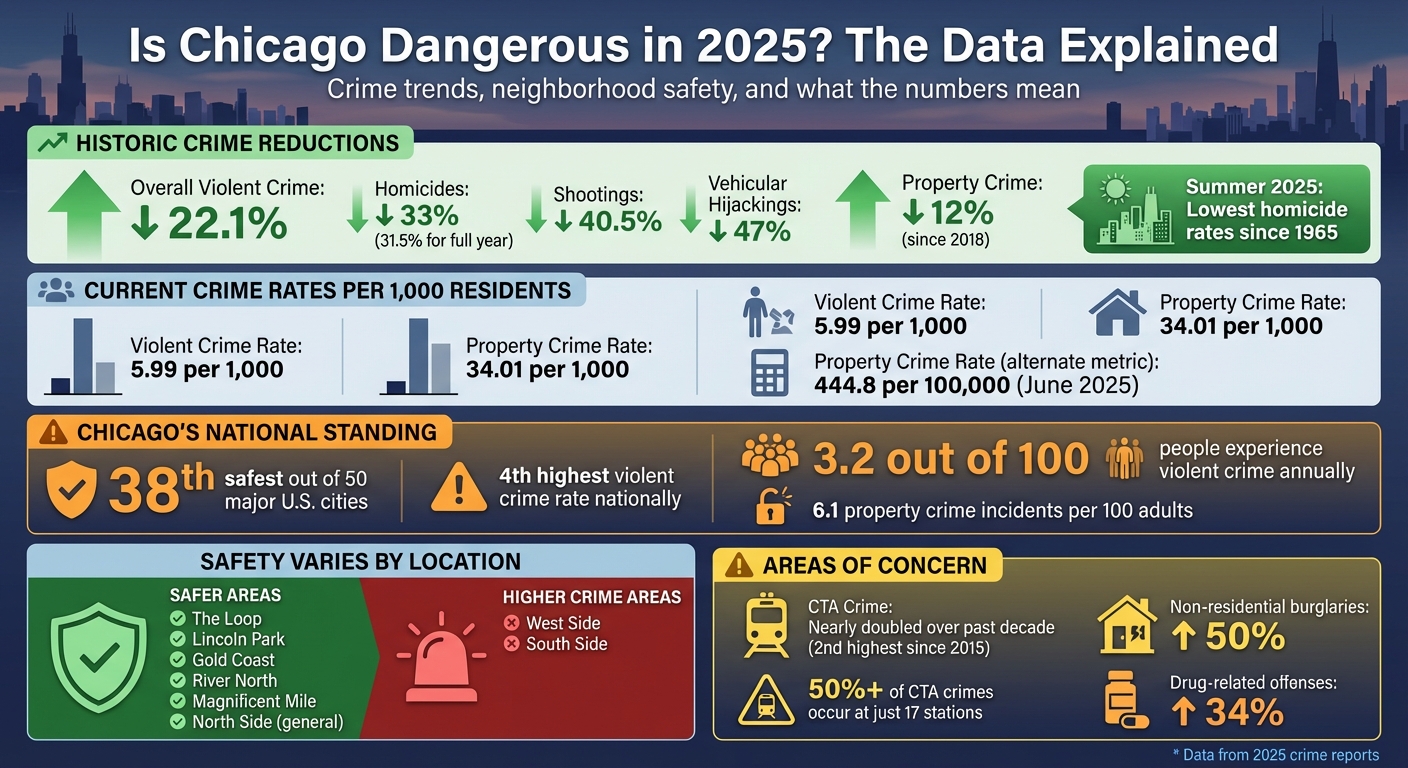
Chicago 2025 Crime Statistics: Key Safety Metrics and Neighborhood Comparison
Chicago sees historic drop in violent crime during first half of 2025
Chicago's 2025 Crime Trends Compared to Past Years
By 2025, Chicago's crime statistics reveal a promising shift, with a notable decrease in violent crime compared to previous years. In fact, the city experienced a 22.1% drop in overall violent crime during the first nine months of the year, leading the nation in this category.
Violent Crime Rates Are Dropping in 2025
One of the most striking improvements is the 33% reduction in homicides during the first half of 2025 - double the national average. The summer months of June, July, and August even saw the lowest homicide rates recorded since 1965. Local efforts, such as community-driven prevention programs and targeted initiatives by law enforcement, have been credited for this progress. Interestingly, federal measures like "Operation Midway Blitz" are viewed as having a smaller, and sometimes even counterproductive, impact on these gains.
Property Crime Numbers and Changes
While violent crime has seen dramatic improvements, property crime has followed a more gradual downward trend. In June 2025, there were 444.8 property crime incidents per 100,000 residents, reflecting a 12% decrease from June 2018 and an 8% decrease from June 2019. Although the decline in property crime is less pronounced than that of violent crime, it still highlights a steady improvement, setting Chicago apart from many other large cities.
How Chicago Compares to Other Major U.S. Cities
Chicago’s achievements in reducing violent crime stand out on a national scale, with its rate of decline far surpassing the broader U.S. trend. This positions the city as a leader among major urban centers in addressing violent crime effectively.
Crime Statistics by Type and Neighborhood
Homicides, Assaults, and Robberies in 2025
In 2025, Chicago's violent crime rate stands at 5.99 per 1,000 residents. While this reflects an overall decline in violent crimes, the improvements are not evenly distributed. The West and South Sides continue to report higher concentrations of incidents like homicides, assaults, and robberies, whereas neighborhoods on the North Side experience significantly fewer violent crimes.
Burglary, Theft, and Vehicle Crime Numbers
Property crimes remain a more common concern for Chicago residents, with a rate of 34.01 per 1,000 residents. Among these, theft is the most prevalent, followed by vehicle-related offenses and burglaries. These crimes are often concentrated in commercial corridors and busy streets, even in neighborhoods generally considered safer [12-14].
Crime Rates Across Different Chicago Neighborhoods
When examining crime rates by neighborhood, stark contrasts emerge. The West and South Sides see significantly higher crime levels, driven by factors like gang activity, economic challenges, and dense populations [12-14]. These areas report elevated rates of both violent and property crimes. On the other hand, neighborhoods on the North Side consistently rank among the safest in the city, with much lower crime rates across all categories [11-14]. This disparity highlights the ongoing challenges in addressing crime in specific parts of Chicago.
sbb-itb-6d427fc
What Crime Data Means for Residents, Workers, and Visitors
Safety Tips for Chicago Residents
In 2025, crime data in Chicago tells a story of progress mixed with ongoing challenges. While violent crime has seen a significant drop, the city’s rates are still well above the average for other large U.S. cities. Safety perceptions differ depending on the time of day and the neighborhood. Most residents feel secure during daylight hours, but only about half report feeling the same after dark. To make informed decisions, it’s important to review localized crime stats rather than relying solely on citywide averages. Tools like AdensZip can help you compare crime data by ZIP code, which is especially useful if you’re considering relocating.
Crime Concerns for People Who Commute to Chicago
For daily commuters, safety concerns extend beyond residential crime. The 2025 data highlights specific issues that don’t always show up in citywide numbers. While violent crime overall has decreased, crime on the CTA has risen. In fact, violent incidents on the CTA have nearly doubled over the past decade, reaching their second-highest level since 2015. More than half of these crimes occurred at just 17 stations. If you’re commuting into the city for work, it’s worth researching the safety records of the stations you frequent. Adjusting your travel times or exploring alternative routes may also help enhance your safety.
Staying Safe as a Tourist in Chicago
Tourists visiting Chicago in 2025 generally find themselves safe in areas that are well-patrolled and popular with visitors. Neighborhoods like The Loop, River North, Lincoln Park, Gold Coast, and Magnificent Mile report lower crime rates compared to other parts of the city. Data shows notable reductions in violent crimes, homicides, and shootings citywide. That said, it’s always wise to stay cautious: stick to well-lit, busy streets after dark and remain aware of your surroundings.
Conclusion: Is Chicago Dangerous in 2025?
Main Findings from the 2025 Crime Statistics
Chicago's safety landscape in 2025 presents a complex picture. On one hand, the city achieved historic milestones, with violent crime reaching its lowest levels in decades. During the summer, the city recorded the fewest homicides since 1965, and the first nine months of the year saw a remarkable 22.1% drop in overall violent crime. Homicides fell by 31.5%, shootings decreased by 40.5%, and vehicular hijackings plummeted by 47% - making Chicago a leader in crime reduction nationwide.
But there's another side to the story. In November 2025, a SmartAsset report ranked Chicago as the 38th safest out of 50 major U.S. cities. Despite the progress, the city still had the fourth-highest violent crime rate, with 3.2 out of every 100 people experiencing violent crime annually. Property crime also remained a concern, with 6.1 incidents per 100 adults. Alarmingly, some property crime categories worsened - non-residential burglaries surged by 50%, and drug-related offenses climbed 34% in the year’s first half.
Safety in Chicago also depends heavily on location. While neighborhoods on the West and South Sides continue to face higher crime rates, areas like The Loop and Lincoln Park - popular among tourists and residents alike - report significantly fewer incidents. Where you live, work, or spend time in Chicago can dramatically shape your experience of the city.
Using AI Tools to Make Better Relocation Choices
These statistics underline the importance of taking a well-rounded approach when evaluating neighborhoods in Chicago. Crime data alone doesn’t tell the full story - it’s just one piece of the puzzle. Other factors like housing affordability, job opportunities, commute times, and local amenities are equally important when deciding where to live.
Enter AdensZip, an AI-powered platform that simplifies the decision-making process. This tool integrates crime data with other key lifestyle indicators, offering detailed reports and livability scores for every ZIP code in Chicago. Whether you're comparing neighborhoods or exploring potential relocation spots, AdensZip provides insights on crime trends, real estate prices, cost of living, and even local job markets. Its AI-generated summaries help translate raw data into practical, everyday implications - making it easier to find a neighborhood that fits your needs and lifestyle. Whether you're moving to Chicago or just curious about its diverse areas, tools like this can help you make smarter, more informed choices.
FAQs
What causes crime rates to vary between Chicago neighborhoods?
Crime rates in Chicago neighborhoods fluctuate for a variety of reasons. Some of the most influential factors include the trust - or lack thereof - between law enforcement and the community, how well violence prevention programs are working, and the focus of policing efforts in high-crime areas. Tackling illegal gun activity is another critical piece of the puzzle.
On top of that, socioeconomic conditions like income inequality and access to essential resources also shape crime patterns. Activities by federal agencies, such as immigration enforcement, can further affect crime trends in specific neighborhoods. These elements often intertwine, creating complex dynamics that lead to noticeable differences in crime rates throughout the city.
How has crime on public transit impacted daily commuters in Chicago?
Recent shifts in crime patterns on Chicago's public transit system are making a difference for daily commuters. Notably, violent crime on the CTA has dropped by 20%, and overall transit-related incidents have also decreased. This progress is helping create a safer space for riders.
These changes highlight the city's ongoing work to improve security and rebuild trust in public transportation. Even so, riders are reminded to stay alert and report any suspicious behavior to keep the system safe for everyone.
How do community programs help reduce crime in Chicago?
Community programs have proven to be a key factor in reducing crime rates in Chicago by tackling the root causes of violence and strengthening neighborhood bonds. Initiatives such as youth employment opportunities, conflict resolution workshops, and collaborations with local organizations play a vital role in building trust and fostering safer environments. These collective efforts have been instrumental in contributing to Chicago's measurable crime reductions as of 2025.
By prioritizing prevention and community involvement, these programs encourage residents to actively participate in enhancing their neighborhoods. This approach not only improves public safety but also elevates the overall quality of life for everyone involved.