Los Angeles Crime Rate 2026: Is LA Safe to Live or Visit?

Los Angeles Crime Rate 2026: Is LA Safe to Live or Visit?
Los Angeles in 2025 shows a mixed safety picture. Crime rates are 29.7% higher than the national average, with violent crime rates double the U.S. average. However, some neighborhoods like Pacific Palisades and Brentwood remain far safer than areas like Downtown LA or Skid Row, where crime rates are significantly higher.
Key takeaways:
- Violent Crime: 760 incidents per 100,000 residents.
- Property Crime: Makes up 75% of all reported crimes.
- Safest Areas: West LA neighborhoods like Brentwood and Beverlywood.
- High-Crime Zones: Downtown LA, Skid Row, and Watts.
- Tourists: Generally safe in monitored zones but should avoid high-crime areas after dark.
Whether you’re planning to live or visit, safety depends on staying informed about neighborhood-specific risks. Tools like AdensZip can help assess crime trends and livability for smarter decisions.
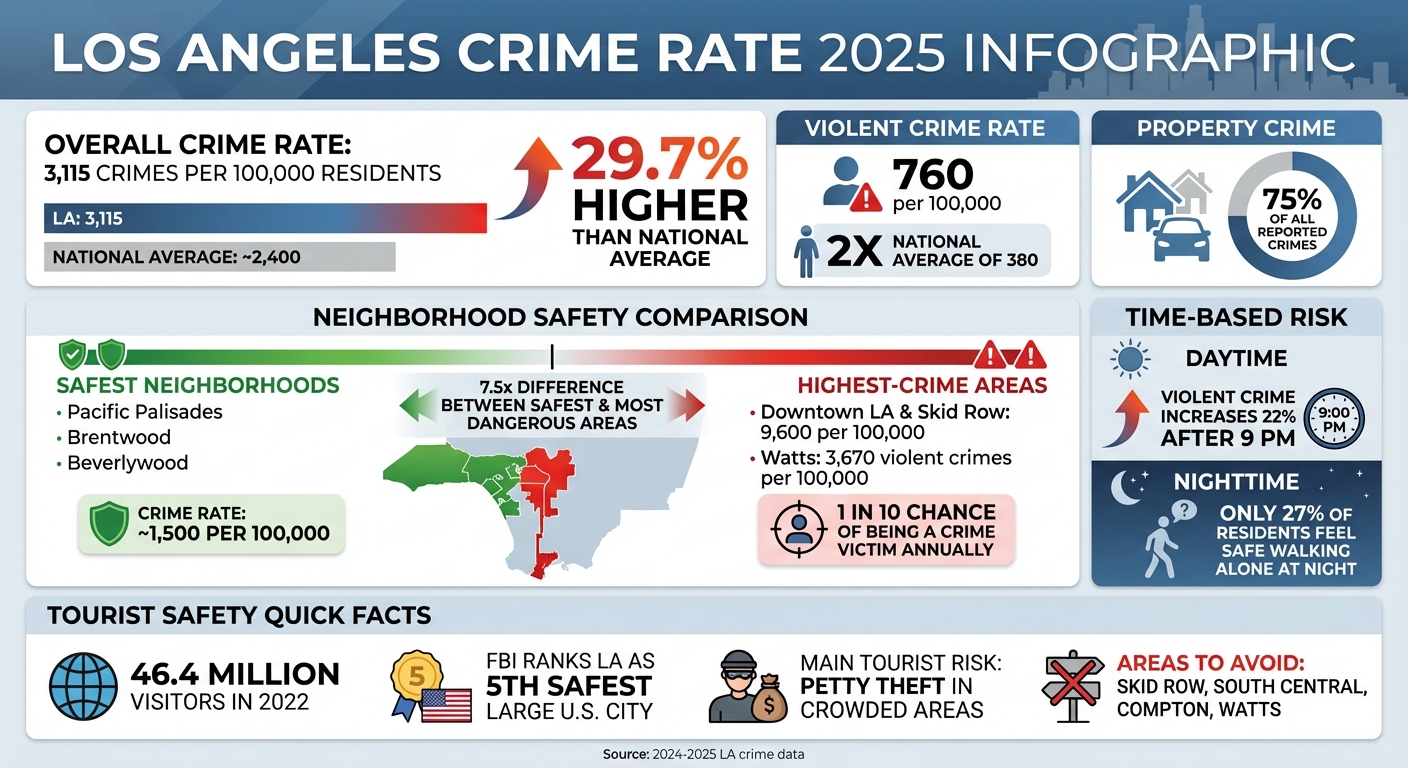
Los Angeles Crime Statistics 2025: Safety by Neighborhood Comparison
Los Angeles Crime Statistics for 2025
2025 Crime Rates in Los Angeles
In 2024, Los Angeles reported approximately 3,115 crimes per 100,000 residents, serving as the baseline for 2025 statistics. This translates to about 3% of the city's population experiencing some form of crime over the year.
Breaking it down, there are two primary categories: violent crime and property crime. The violent crime rate stands at roughly 760 incidents per 100,000 residents, encompassing offenses like homicides, aggravated assaults, and robberies. Meanwhile, property crimes, which include burglary, theft, and motor vehicle theft, account for the majority of reported incidents.
These numbers align with broader trends, though crime levels can vary significantly from one neighborhood to another. Having a clear understanding of these statistics provides a deeper perspective beyond the headlines. Next, we’ll see how Los Angeles compares to national crime averages.
LA vs. National Crime Averages
The overall crime rate in Los Angeles is 29.7% higher than the national average. When it comes to violent crime, LA's rate of 760 incidents per 100,000 residents is double the national average of 380. However, the city fares better than some major urban areas like Chicago, Detroit, and St. Louis.
This positions Los Angeles somewhere in the middle among large U.S. cities - not the safest, but far from the most dangerous. For both residents and visitors, understanding crime at the neighborhood level is key, which we’ll explore further in the next section.
Neighborhood Safety: Where Crime Rates Vary Most
Safest Neighborhoods in Los Angeles
When it comes to safety in Los Angeles, Pacific Palisades, Brentwood, and Beverlywood consistently top the list. These neighborhoods maintain steady crime rates throughout the day, offering residents a similar sense of security whether they're out and about at noon or late at night. To put it into perspective, the crime rates in these areas are about 7.5 times lower than those in LA's most dangerous neighborhoods.
Neighborhoods in West LA and the San Fernando Valley also rank high for safety. This is largely due to strong community networks, active neighborhood watch programs, and vigilant security measures. These areas are particularly appealing to families and professionals who value stable environments, quality schools, and higher property values. The combination of engaged residents and economic stability creates a natural shield against crime.
High-Crime Areas and Hotspots
On the flip side, Downtown Los Angeles and Skid Row are among the city's most crime-ridden areas, with crime rates reaching approximately 9,600 incidents per 100,000 residents. This translates to a 1 in 10 annual chance of becoming a victim of crime in these areas. Watts also stands out for its violent crime rate, which is around 3,670 incidents per 100,000 residents.
These high-crime zones face complex challenges, including poverty, gang activity, drug-related offenses, and homelessness. While Los Angeles County has seen an overall decline in crime, these neighborhoods remain outliers, with rates that far exceed city and national averages. The concentration of crime in these areas has a significant impact on LA's overall crime statistics, painting a stark contrast to the city's safer neighborhoods.
When and Where Crime Happens Most
Violent crime in Los Angeles tends to spike by 22% after 9 PM, particularly in densely populated areas like Downtown and Hollywood. In contrast, affluent neighborhoods on the west side of the city maintain a steady level of safety throughout the day and night. Interestingly, only 27% of LA residents report feeling safe walking alone at night.
Seasonal trends also play a role in crime patterns. From August 2023 through December 2023, incidents of personal theft and burglary increased, but these numbers dropped again by February 2025. Meanwhile, crimes like aggravated assaults, motor vehicle theft, and homicides showed a general downward trend during the same period. Well-lit, bustling commercial areas such as parts of West Hollywood, Studio City, and Culver City tend to remain safer after dark compared to less populated or poorly lit streets. These trends highlight the importance of precise, data-driven safety insights to help residents and visitors navigate the city more securely.
Is Los Angeles Safe to Live or Visit in 2025?
Safety for Residents
When it comes to living in Los Angeles, safety largely depends on the neighborhood you choose. The city’s layout creates noticeable differences in crime rates, with some areas - like parts of Downtown or Watts - experiencing higher incidents compared to quieter neighborhoods. For residents, property crimes such as auto theft and burglary remain the most common issues, though there have been improvements in these trends throughout 2025.
The ongoing fentanyl crisis also plays a role, contributing to certain overdose-related crimes. Even though major crime categories have seen declines, public perception often lags behind the actual statistics. Generally, westside neighborhoods remain safe at all hours, while high-density areas tend to see more incidents after dark. By staying informed and actively participating in community safety efforts, residents can significantly enhance their local security.
Tourist safety, however, presents a different set of challenges tied to short-term stays and specific locations.
Safety for Visitors
Los Angeles continues to attract millions of tourists, with 46.4 million visitors in 2022 alone. As of 2025, the city remains a relatively safe destination for travelers. Most popular attractions are located in secure, affluent neighborhoods, and the FBI ranks LA as the 5th safest large city in the U.S.. Its crime rates are notably lower than those of cities like San Francisco, Las Vegas, and New Orleans.
For tourists, the primary risks are petty theft and pickpocketing, particularly in crowded spots like the Hollywood Walk of Fame, Venice Beach, and Santa Monica Pier. To stay safe, it’s crucial to keep valuables concealed and stay vigilant. Certain areas, such as Skid Row, South Central LA, Compton, and Watts, should be avoided, especially after dark. Downtown Los Angeles, for example, has a crime rate of 255.8 per 1,000 residents - 743% higher than the city average. Similarly, Hollywood sees nearly 5,000 crimes per 100,000 residents annually. That said, most tourist activity occurs in well-monitored commercial zones, which are generally safe.
These differences in safety concerns for residents and visitors highlight the unique challenges each group faces.
Living vs. Visiting: Safety Comparison
| Factor | Residents | Visitors |
|---|---|---|
| Main Crime Risks | Property crimes like auto theft and burglary; some neighborhood-specific violent incidents | Petty theft and pickpocketing in busy tourist areas |
| Geographic Impact | High - safety is tied to neighborhood and daily routines | Low - tourists typically stay in safer zones |
| Time Commitment | Ongoing vigilance, community involvement, and home security | Short-term awareness during the visit |
| Risk Mitigation | Choosing safer neighborhoods, using security systems, and staying informed | Avoiding high-crime areas and securing belongings |
| Nighttime Safety | Varies by neighborhood; extra caution in busy areas | Manageable with careful planning |
For residents, safety involves long-term decisions about where to live and how to navigate daily life. Tourists, on the other hand, face more immediate, location-specific risks, often centered around theft in crowded attractions.
sbb-itb-6d427fc
Using AI Tools to Assess LA Safety
AdensZip Crime and Safety Features

Advanced AI tools like AdensZip are making it easier to understand safety dynamics across Los Angeles. By analyzing crime trends and neighborhood differences, AdensZip transforms raw data into practical insights. Its Crime Intelligence and Livability Score features provide a clear picture of local crime patterns and overall safety, taking into account factors like climate, cost of living, and available amenities. Plus, the Real Estate Data tool links safety statistics with housing trends, helping users make smarter decisions about relocating or visiting various parts of LA. Together, these tools offer a well-rounded view for anyone evaluating neighborhoods in the city.
How to Use AdensZip for Safety Research
Using AdensZip for safety research is straightforward. Select a Los Angeles neighborhood to access detailed reports on crime trends and livability scores. The News Pulse feature keeps you informed about the latest safety updates, ensuring your decisions are backed by real-time, reliable data. This methodical approach makes navigating LA's safety landscape easier and more informed.
Conclusion: Understanding LA's Safety in 2025
Main Findings on LA Safety
In 2024, Los Angeles saw some promising trends: homicides dropped by 14%, and the number of shooting victims fell by 19%. However, the overall crime rate in LA remains about 30% higher than the national average, standing at 3,115 crimes per 100,000 residents. The city’s safety often depends heavily on the neighborhood, with a striking sevenfold difference in crime rates across different areas.
Property crimes make up roughly 75% of all reported incidents, and localized issues, like a 250% increase in fentanyl-related arrests in Hollywood, highlight specific challenges. Despite improvements in major crime categories, half of LA's residents still believe crime is on the rise. This disconnect between perception and reality underscores the importance of relying on accurate data to understand the city's safety landscape.
Making Informed Decisions About LA
The data paints a nuanced picture of safety in Los Angeles, offering valuable insights for decision-making. The city’s crime rates vary dramatically by neighborhood. For instance, areas like Downtown LA and Skid Row report alarmingly high crime rates - over 9,000 incidents per 100,000 residents. In contrast, neighborhoods such as Bel Air, Pacific Palisades, and Brentwood consistently show much lower rates, often below 1,500 per 100,000 residents. These differences don’t just affect safety - they also impact real estate. A drop in a neighborhood’s crime index can add approximately $140,000 to median home prices, with safer neighborhoods experiencing faster appreciation, typically growing 4–6% more over five years.
Tools like AdensZip's Crime Intelligence and Livability Score provide detailed, up-to-date information, enabling users to assess safety and livability on a granular level. Instead of relying on broad averages or anecdotal evidence, these tools offer insights into crime trends, real estate data, and livability metrics specific to individual neighborhoods. Whether you’re planning a visit or considering a move, this data-driven approach ensures decisions are rooted in facts, making it easier to navigate LA’s complex safety dynamics. AI-powered insights like these can bridge the gap between perception and reality, helping both residents and visitors make well-informed choices.
Criminology expert discusses the drop in Los Angeles homicide rates
FAQs
How safe is Los Angeles compared to other major U.S. cities?
Los Angeles has seen some encouraging improvements in safety, with a 14% decrease in homicides and a continued drop in violent crime since 2021. That said, the city still ranks safer than only about 7% to 29% of U.S. cities, depending heavily on the neighborhood.
Certain areas, like Downtown and Skid Row, are known for higher crime rates. On the other hand, neighborhoods such as Bel Air and Pacific Palisades are recognized for being much safer. If you're planning to live in or visit Los Angeles, it's a good idea to research specific neighborhoods and keep up with local safety trends to make informed decisions.
What are the safest neighborhoods to live in or visit in Los Angeles in 2025?
In 2025, some of the safest neighborhoods in Los Angeles include Mount Washington, Beverlywood, Porter Ranch, Bel Air, Pacific Palisades, Westwood, Cheviot Hills, Rancho Park, Encino, and Sherman Oaks. These areas stand out for their low crime rates, strong sense of community, and overall reputation for safety, making them appealing for both residents and visitors alike.
That said, even in these neighborhoods, it’s wise to stay informed about local conditions and practice basic safety measures. Whether you’re planning a move or just exploring the city, tools like AI-based analytics or local resources can provide tailored insights to help you make informed decisions.
What are the best ways to evaluate neighborhood safety in Los Angeles?
When assessing neighborhood safety in Los Angeles, consider using AI-powered safety tools, detailed crime data, and official reports from local law enforcement. These resources give a clear picture of crime patterns and can help pinpoint areas with lower crime rates.
Beyond data, insights from community safety programs and feedback from local residents can shed light on the everyday safety of specific neighborhoods. By combining these resources, you’ll gain a more complete understanding of the area.