Columbus Safety Breakdown – 2026 Crime Statistics Revealed
Columbus Safety Breakdown – 2026 Crime Statistics Revealed
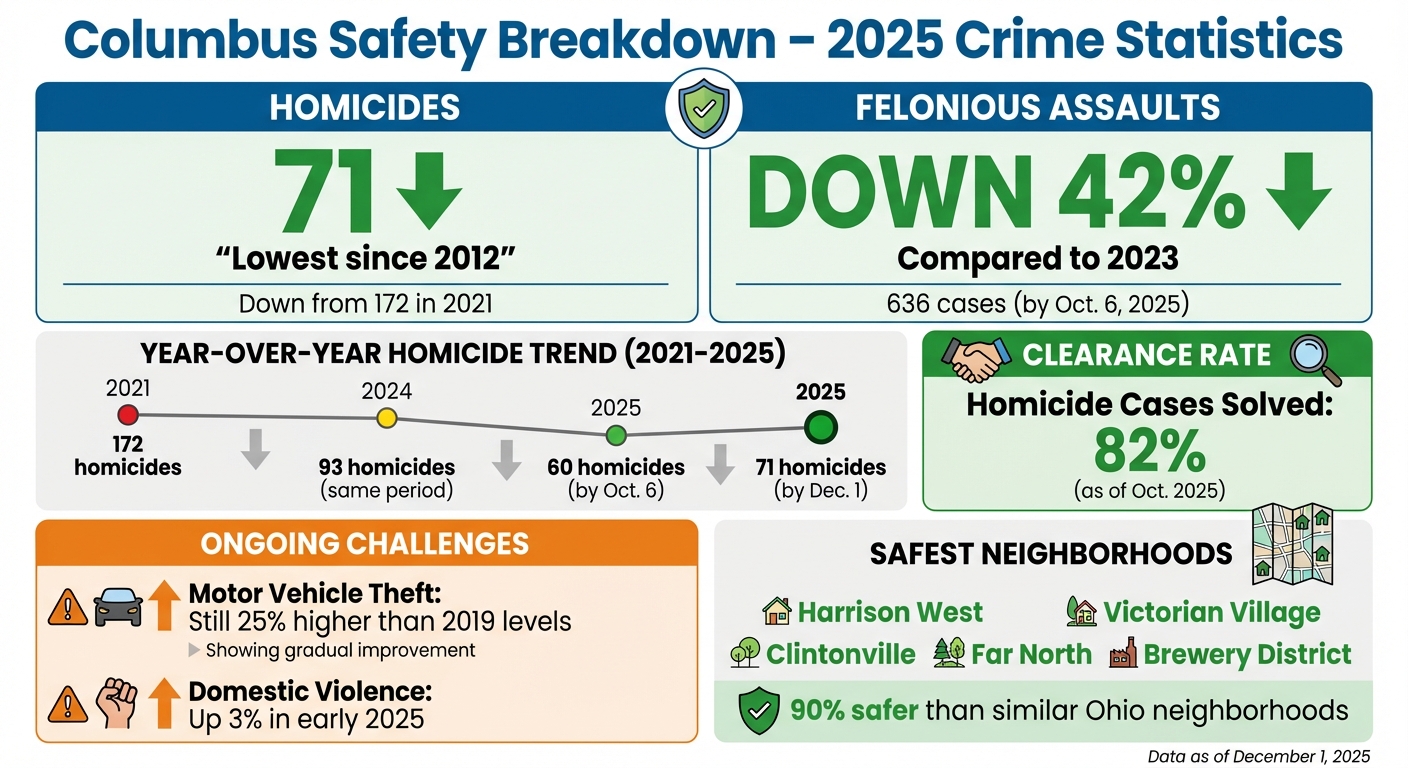
Columbus has made major progress in public safety this year. By December 1, 2026, the city recorded just 71 homicides - the lowest annual total since 2012 and a stark improvement from 172 in 2021. Felonious assaults dropped 42% compared to 2023, reflecting a broader decline in violent crime across the U.S. However, challenges remain, particularly with motor vehicle theft, which is still 25% higher than pre-pandemic levels.
Key Highlights:
- Homicides: 71 reported by Dec. 1, the lowest annual total since 2012.
- Violent Crime: Felonious assaults down 42% since 2023.
- Motor Vehicle Theft: Still a problem, but showing gradual improvement.
- Neighborhood Safety: Areas like Harrison West and Clintonville are among the safest, while others face ongoing struggles tied to economic inequality.
These trends show Columbus is becoming safer overall, but some issues persist. Accurate data and local insights remain critical for understanding safety at the neighborhood level.
Columbus Crime Statistics 2025: Key Safety Trends and Improvements
2025 Crime Trends in Columbus
Overall Crime Rates and Year-Over-Year Changes
As of October 6, 2025, Columbus reported 60 homicides - the lowest number since 2013. This marked a sharp drop of about one-third compared to the 93 homicides recorded during the same period in 2024. Felonious assaults also saw a decline, aligning with similar patterns observed across the country. By December 1, 2025, the city’s annual homicide count reached 71, continuing this promising downward trend.
While violent crimes showed notable decreases, property crimes told a more complex story with mixed results.
Citywide Crime Declines and Increases
Most crime categories in Columbus experienced declines in 2025. However, motor vehicle theft remained a persistent issue, though it showed gradual improvement in line with national patterns.
In general, Columbus’s crime trends in 2025 reflected broader changes seen in major metropolitan areas, with a continued reduction in violent crime leading the way.
Violent Crime in Columbus
Homicide and Shooting Statistics
In 2025, Columbus achieved a milestone in public safety, recording its lowest homicide rate since 1978. By December 1, only 71 homicides were reported - marking the lowest annual total since 2012 and the third-lowest since 2000. This is a stark contrast to the 172 homicides recorded in 2021.
Felonious assaults also saw a sharp decline, with 636 cases reported by October 6, 2025. This represents a 25% drop compared to 2024 and an impressive 42% decrease from 2023. However, firearms still played a significant role in violent crimes, with 145 out of 230 felonious assault cases involving guns by April 28, 2025. The Columbus Division of Police reported clearing about 82% of homicide cases as of October 2025.
"We're very proud that Columbus is presently the safest it's ever been, with homicides at a more than 12-year low, even as the city has grown." - Jennifer Fening, Deputy Chief of Staff to Mayor Andrew Ginther
These numbers highlight a major shift in crime trends, setting the stage to explore changes in offender profiles.
Offender Demographics in Violent Crime
Early data suggests that a reduction in risky behavior among juveniles has played a key role in the drop in violent crime rates. Columbus has been tracking offender demographics - categorized by race, gender, and age - since 2004, with the latest updates extending through 2025.
Property Crime in Columbus – 2025 Data
2025 Property Crime Rates Compared to Previous Years
Columbus has seen a decline in property crime, following the same downward trend observed across the nation. In 2024, the city reported a property crime rate of 2,653.3 incidents per 100,000 residents. This drop aligns with national statistics, where property crime decreased by 8% in 2024 compared to 2023.
Theft remains the most common type of property crime in Columbus. However, the overall decline in property crime contrasts with ongoing challenges related to motor vehicle theft.
What's Driving Motor Vehicle Theft in Columbus
Motor vehicle theft has taken a different path compared to other property crimes. In recent years, it has surged, reaching a 17-year high in 2022. A significant factor behind this spike was the security vulnerabilities in certain Kia and Hyundai models, which made these cars especially easy targets.
On a national scale, motor vehicle theft also hit a peak in 2023, with 319 incidents per 100,000 people - the highest rate since 2007. This rise began in the summer of 2020 and continued until 2023. However, the trend started to reverse in 2024, and the first half of 2025 recorded a 25% drop compared to the same period in 2024 across 36 U.S. cities. February and June 2025 marked the most significant declines, with theft rates dropping by 30% and 28%, respectively.
While these national trends offer some hope, Columbus continues to face challenges in catching up. Motor vehicle theft rates in early 2025 were still 25% higher than they were in 2019.
Columbus Neighborhood Safety Rankings
Safest Neighborhoods in Columbus
Columbus sits at a C- crime grade, placing it in the 33rd percentile for safety. However, when you zoom in on individual neighborhoods, the picture becomes much clearer, and the differences are striking.
Some of the safest neighborhoods in Columbus include Harrison West, Victorian Village, Clintonville, Far North, and the Brewery District. These areas are considered nearly 90% safer than similar neighborhoods across Ohio. With lower crime rates and strong community safety measures, these neighborhoods are particularly appealing to those prioritizing peace of mind.
Citywide statistics don’t tell the whole story. Columbus is seeing progress in safety overall, with 2025 off to a promising start as homicides and felonious assaults decline. However, safety levels can vary significantly depending on the area. While the city as a whole is improving, these variations underline the importance of neighborhood-level data when assessing safety.
High-Crime Neighborhoods and Contributing Factors
On the other side of the spectrum, certain neighborhoods in Columbus face ongoing safety challenges. Violent crimes are often concentrated in specific areas, and understanding the reasons behind this requires examining the broader context.
Economic struggles play a major role in driving crime rates in these neighborhoods. Poverty levels in some parts of Columbus are significantly higher than regional averages, with Black residents experiencing poverty at twice the rate of the general population. The Benchmarking Central Ohio 2024 Report highlights the city’s struggles with economic inequality and its connection to crime:
"Prosperity is still far out of reach for many Columbus residents, however. Among the cohort, Columbus ranked high on poverty measures, with the second highest percentage of working-age population working and still in poverty, fifth in overall poverty, and eighth in percentage of population below 200% of the federal poverty level." - Benchmarking Central Ohio 2024 Report
Economic disparity, coupled with poor health outcomes, creates an environment where crime is more likely to thrive. While the city has made progress in reducing crime overall, tackling these root causes is critical for creating lasting change in neighborhoods that continue to struggle.
sbb-itb-6d427fc
AI-Driven Crime Data Analysis
AdensZip's Crime Intelligence Feature

AdensZip's Crime Intelligence feature offers in-depth safety insights at the neighborhood level. For $9.99 per month, subscribers gain access to detailed crime analytics, including livability scores, real estate trends, and cost-of-living comparisons across Columbus neighborhoods. This comprehensive data provides a clear picture of local safety and quality of life, while offering a glimpse into the sophisticated AI technology working behind the scenes.
How AI Compiles and Analyzes Crime Data
AdensZip leverages cutting-edge AI to turn raw crime statistics into meaningful insights. By integrating various crime metrics, the platform generates personalized reports that highlight property and violent crime trends, along with overall safety scores. These tools equip both residents and investors with the knowledge they need to make confident, well-timed decisions in Columbus.
Columbus homicides down 30% compared to last year
Conclusion – Columbus Safety in 2025
Columbus has hit a milestone in public safety this year, showing a remarkable shift in crime trends. By December 1, 2025, the city reported just 71 homicides - its third-lowest figure since 2000 - and a 42% drop in felonious assaults compared to 2023. These numbers paint a picture of real progress.
Yet, there's a gap between reality and perception. An NPR/Ipsos poll from September 2025 revealed that 48% of Americans believe crime has increased over the past year, despite clear evidence of significant declines in major cities. As Ernesto Lopez, a Senior Research Specialist at the Council on Criminal Justice, aptly explained:
"Generally speaking, the rates at which people perceive crime is going up do not match overall crime."
However, not all statistics tell the same story. Motor vehicle theft remains 25% higher than pre-pandemic levels, and domestic violence incidents saw a 3% increase earlier this year. These exceptions remind us that while progress is evident, challenges persist.
This mix of trends underscores the importance of accurate, timely data. AI-driven tools now provide hyper-local insights, cutting through outdated statistics. Whether you're considering a move, an investment, or just assessing your neighborhood, these tools empower residents to make informed decisions about Columbus's safety in 2025.
FAQs
What led to the notable decrease in homicides in Columbus in 2025?
The sharp decline in homicides in Columbus during 2025 can be linked to a mix of impactful initiatives and strategies. A stronger partnership between law enforcement and local communities played a big role, fostering trust and cooperation. Programs like Columbus Violence Reduction introduced proactive measures to prevent violence before it escalated. On top of that, public safety improvements, such as better lighting and increased security in high-risk neighborhoods, made a noticeable difference.
Law enforcement also shifted to more effective approaches. Team-based homicide investigations and advanced case-solving methods allowed them to tackle violent crime more efficiently. Together, these efforts created a safer and more secure environment throughout the city.
Why does motor vehicle theft remain a significant problem in Columbus despite a drop in overall crime rates?
Motor vehicle theft remains a pressing issue in Columbus, with a notable spike in cases involving specific car brands like Kias and Hyundais. This increase has driven vehicle theft rates to heights not seen in 17 years. Tackling these thefts has been particularly difficult, even as other crime categories in the city have shown a decline.
How does economic inequality affect crime rates in Columbus neighborhoods?
Economic inequality has a noticeable impact on crime rates in Columbus neighborhoods. Communities with higher poverty levels often face elevated rates of violent and property crimes. This connection stems from limited access to essential resources, fewer economic opportunities, and weaker social support systems. These challenges can heighten tensions and contribute to conditions where crime becomes more prevalent.
Investing in these communities and implementing support programs can play a key role in reducing crime and enhancing safety for residents.